
Interledger
Last reviewed: Aug 21, 2026
Building and maintaining the services necessary participate on the Interledger network can be a time consuming and complex undertaking. As a reference implementation of the Interledger stack, Rhyza gives FSPs all the tools they need to join the network and enable Interledger capabilities on their users’ accounts.
At the core of Interledger is the Interledger Protocol (ILP). It’s a request/response protocol where requests and responses are ILP packets.
These packets of data carry information about a payment. Typically, information about a single aggregate payment from sender to receiver is split into multiple ILP packets.
Each packet represents a conditional IOU which affects financial accounting balances between peers. Amounts adjust based on the payment sender’s asset, the receiver’s asset, and Rhyza’s configured exchange rates service. Then, the amounts are used to update peer liquidity in Rhyza’s ledger.
Interledger itself is a network of computers that enables sending payment messages across payment networks. Each computer on the network is a node.
For two nodes on the Interledger network to exchange ILP packets with one another, the two nodes must be peers. There are a number of requirements that an FSP and its potential peer must meet to form a peering relationship.
Since the purpose of peering is to facilitate payments, which often involves extending lines of credit, FSPs should only peer with entities they trust. We strongly recommend potential peers define their expectations and outline their agreements in a legally binding document before peering with one another.
Each node on the Interledger network can take on the role of sender, connector, or receiver, depending on the payment.
- Sender - Originates the payment by sending ILP packets.
- Connector - An intermediary between a sender and receiver that forwards ILP packets. Connectors can facilitate payments to or from anyone they’re peered with.
- Receiver - The final recipient of the ILP packets and, as such, the payment.
If the sender and receiver nodes are peers, then the payment flow is straightforward and no intermediary connector nodes are needed. However, if the sender and receiver aren’t peers, then the payment must route through one or more connectors. Rhyza includes an Interledger connector for sending and receiving ILP packets.
In the image below, the sender node (A) and the receiver node (C) share a common peer (B). In payments from the sender to the receiver, node B performs the role of connector to facilitate payments between the two.
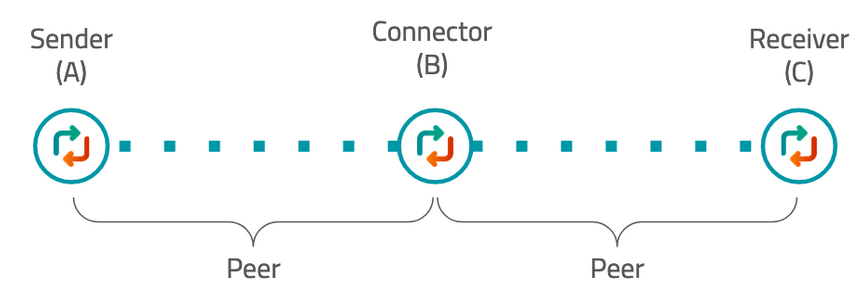
In reality, there can be multiple connectors between a sender node and a receiver node. As more nodes that support different assets peer with one another, the easier it becomes for payments to traverse the Interledger network.
The STREAM Protocol is the transport layer protocol in the Interledger Protocol stack. STREAM sets up a connection between two counterparties to facilitate direct payments over Interledger.
Rhyza’s Interledger connector supports sending and receiving STREAM packets. STREAM packets are encoded, encrypted, and sent as the data field in ILP packets. The protocol uses the shared secret to authenticate and encrypt packets, and to generate conditions and fulfillments.
A critical function of STREAM is to determine the path exchange rate and handle any changes in the rate. Rhyza’s exchange rates service allows FSPs to provide exchange rate information.