Architecture
Last reviewed: Aug 21, 2026
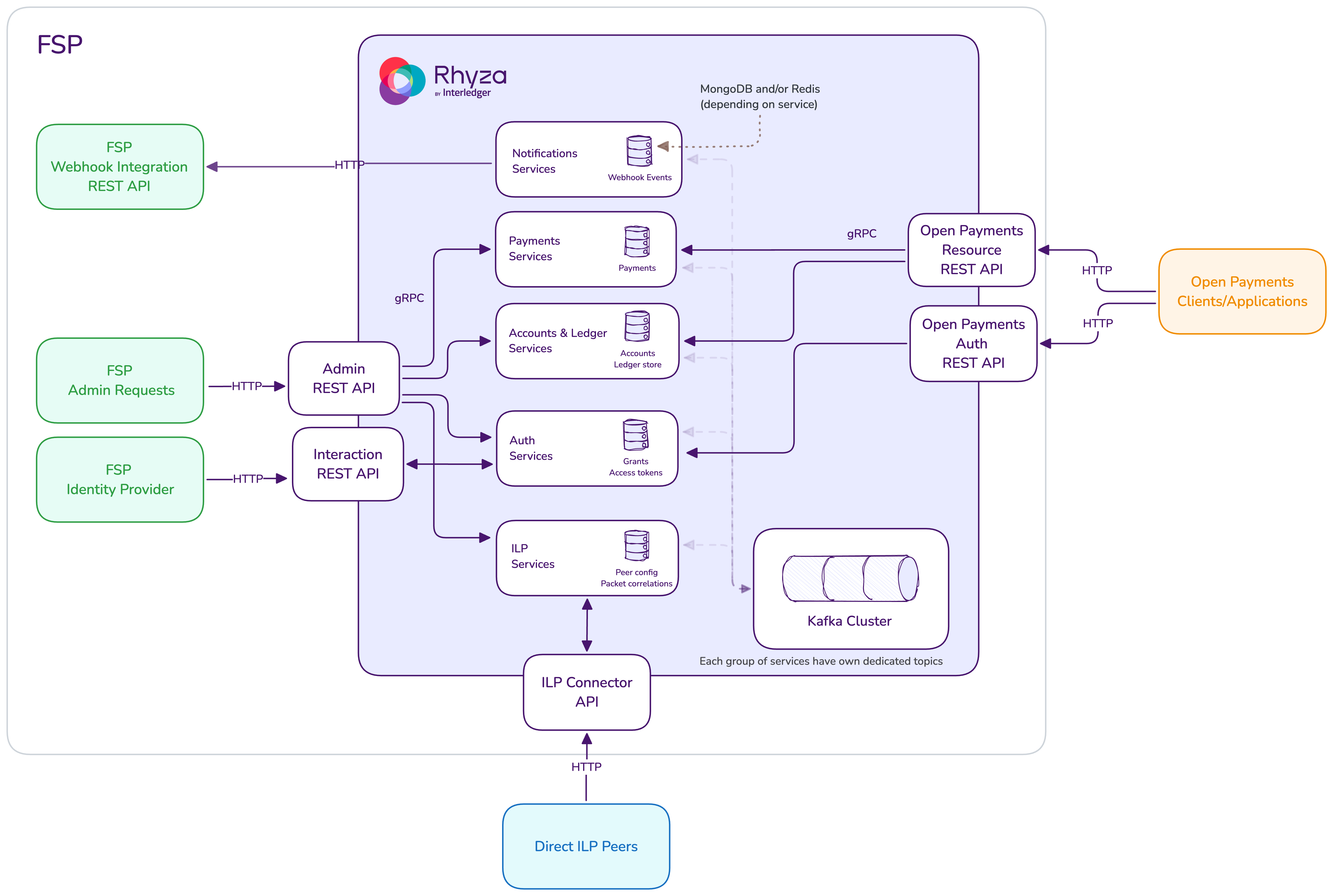
Rhyza is designed to prioritize horizontal scalability, ease of integration, and high performance. From an integration perspective, Rhyza’s architecture consists of three primary areas:
The core system houses Rhyza’s central business logic and data storage. The Admin API and Open Payments APIs act as interface layers that call the core system services to execute actions and manage resources.
Specifically, the core system:
- Stores assets, wallet addresses, and Open Payments grants
- Calculates payment quotes
- Processes payments, routing STREAM and ILP packets between peers
- Maintains the double-entry accounting ledger and peer balances
- Manages peering configuration
- Dispatches webhook events asynchronously to the FSP
The Admin API service is the internal, private REST interface used by the FSP to call the core system for administrative tasks. Through this API, the FSP can do actions such as:
- Configure supported asset types
- Register wallet addresses
- Manage peering relationships and liquidity
- Dynamically update exchange rates
The Open Payments authorization and resource servers are external-facing standalone services that enable public third-party integration.
- Authorization server - Implements the GNAP protocol so third-party applications can request client access grants and tokens from account holders.
- Resource server - Exposes standard endpoints for wallet addresses, quotes, and incoming/outgoing payment resource tracking.
Rhyza relies on modern infrastructure for high performance and scalability.
- MongoDB - The default database used for high write throughput and native horizontal scalability.
- Kafka - The foundation for the event-driven architecture, enabling asynchronous processing.
- Custom accounting ledger - An event-sourced ledger built directly on Kafka that provides a highly performant, auditable accounting system.
- Redis - Used as a cache for sharing STREAM connection details and session data across processes.